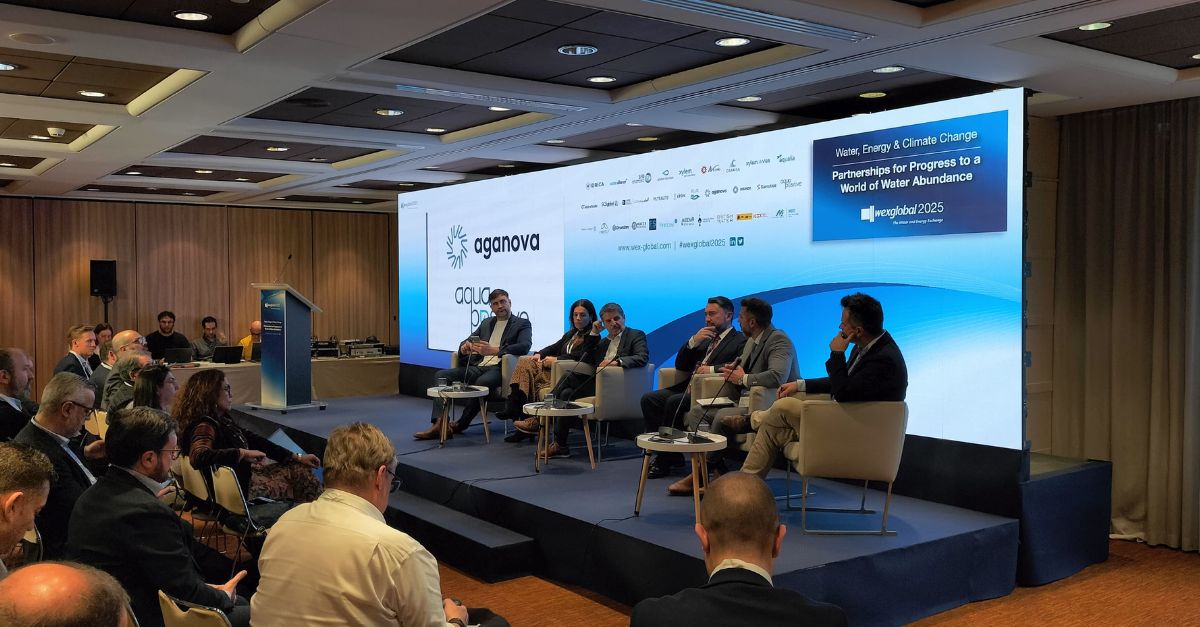
- At WEX Global 2025, Aganova emphasized the critical role of technology and Public-Private Partnerships (PPPs) in achieving a Water Positive future, demonstrating how leak detection solutions can drive real impact on water sustainability with fast implementation and measurable results.
Valencia, Spain | February 14, 2025 — From February 10 to 12, WEX Global 2025 brought together water leaders, policymakers, and innovators to address key challenges in sustainable water management.
As a Technology Sponsor, Aganova contributed significantly to the event, highlighting the importance of technology and Public-Private Partnerships (PPPs) in building a Water Positive future.
Aganova’s Vision for Impactful Water Sustainability
At WEX Global, Aganova emphasized how advanced leak detection technologies can deliver fast, measurable results that drive water sustainability.
Moreover, these solutions can be deployed quickly and cost-effectively, unlike large-scale civil infrastructure projects.
The company showcased its leadership in Non-Revenue Water (NRW) reduction and water replenishment strategies, positioning technology as a key enabler of global stewardship goals.
Panel Discussion: Building a Water-Positive World
On February 11, Francisco J. Muñoz, Aganova’s International Business Development Director, joined a high-level panel titled: “Sustainable Solutions – Building a Catalytic Community for a Water-Positive World”
During the session, Francisco called for a broader water strategy—one that goes beyond conservation to include active replenishment of natural sources.
Specifically, he outlined how Aganova’s Nautilus system detects and locates leaks in large-diameter pipelines, enabling utilities to act quickly and reduce losses significantly.
These actions support both corporate water stewardship and the resilience of water-stressed regions—especially in Mediterranean and inland areas where desalination is not viable.
The Role of Public-Private Partnerships
Francisco also stressed that Public-Private Partnerships (PPPs) are essential to transforming water replenishment projects into scalable, long-term programs.
By aligning the efforts of corporations, utilities, and technology providers, stakeholders can accelerate implementation and unlock greater impact.
This model makes sustainability goals achievable—not only in theory, but in practice.
Roundtable: Water Stewardship for Broader SDG Impact
Later the same day, Francisco participated in a roundtable titled: “Water Stewardship as a Catalyst for Sustainability Goals”
The discussion explored collaborative models like water balancing and replenishment, which deliver environmental and social impact.
In particular, panelists discussed how integrated stewardship can contribute to all 17 UN Sustainable Development Goals (SDGs).
SDG 17 (Partnerships for the Goals) emerged as a central theme—highlighting the importance of multi-stakeholder collaboration to maximize environmental and social outcomes.
Leak Detection as a Key Replenishment Strategy
One of Aganova’s core messages at WEX Global 2025 was clear: Reducing NRW is one of the fastest and most impactful ways to replenish water.
Unlike infrastructure-heavy solutions, leak detection requires minimal intervention and provides immediate, quantifiable benefits.
These technologies create a triple-win:
-
For companies advancing their sustainability agendas
-
For utilities strengthening reliability and reducing losses
-
For communities securing long-term access to water
Aganova’s Ongoing Commitment
Aganova remains committed to advancing water stewardship through technology and collaboration. The company continues to support global partners in driving sustainable, efficient, and equitable water management models.
And remember: THERE IS NO GREEN WITHOUT BLUE.