City of Phoenix Leak Detection Pilot project
Executive Summary
As part of a broader infrastructure planning effort, the City of Phoenix partnered with HDR Engineering, WaCo Contracting, and Hydromax USA to test the Nautilus System, an advanced inline leak detection technology developed by Aganova. The trial, conducted on two barwrapped steel transmission mains totaling 6.5 kilometers, aimed to assess the system’s precision, reliability, and cost-effectiveness as a long-term asset management solution.
Phoenix operates one of the largest municipal water systems in the United States, supplying drinking water to over 1.5 million residents through more than 11,000 kilometers of pipelines. In response to aging infrastructure and the need for proactive maintenance, the city identified Nautilus as a promising tool to enhance leak detection and reduce water losses without interrupting service.
The inspection, executed jointly by Hydromax USA and Aganova, resulted in the detection of three leaks and one air pocket—two of which were confirmed through excavation. One leak was even detected in an adjacent pipeline not part of the original scope. The accuracy and efficiency of Nautilus not only surpassed conventional methods but also offered a non-invasive, costeffective alternative that supports the city’s sustainability goals.
Client
Partner
Sections
2 bar-wrapped steel pipelines
Location
Phoenix, Arizona, USA
Date
2019
Diameter
DN500 – DN600
Speed (m/s)
Min
Max
0.3
0.3
Pressure (bar)
Min
Max
1
4
Distance (m)
6,500
Introduction
The City of Phoenix, Arizona, serves more than 1.5 million residents through a vast water distribution network comprising over 11,000 kilometers of transmission pipelines, 50,000 hydrants, and 119,000 valves. As part of its ongoing commitment to asset management and sustainable infrastructure, the city sought advanced tools to assess and maintain its aging water mains. The Nautilus System was selected for a field trial to evaluate its potential as a core technology in the city’s long-term pipeline monitoring strategy.
Challenge
Aging infrastructure and hidden leaks represent a significant challenge for water utilities across the U.S. Phoenix needed a non-invasive, accurate method to detect leaks and anomalies in large-diameter pipelines without service disruption or extensive excavation. The key objectives were:
- Identify hidden leaks and air pockets in two selected sections of watermain (totaling 6.5 km).
- Compare Nautilus’ performance to traditional inspection methods.
- Evaluate cost, accuracy, and operational impact.
Solution and Implementation
The project involved the inspection of two pipeline sections using the Nautilus System:
- Section A: 3,900 meters of Ø600 mm bar-wrapped pipe (AWWA C303)
- Section B: 2,600 meters of Ø600–500 mm bar-wrapped pipe
Pre-Assembly: Synchronizers were installed using existing infrastructure (valves, hydrants) to provide accurate location references for the Nautilus sphere during its navigation.
Insertion & Navigation: The Nautilus sphere, characterized by neutral buoyancy, was introduced into the water flow through a valve. It navigated passively along the center of the pipe, recording acoustic signals associated with leaks, air pockets, or other anomalies. Its neutral buoyancy ensured optimal movement, avoiding obstacles and maximizing data accuracy.
Extraction: At the end of each section, a retrieval net system was used to safely extract the sphere. The sphere’s acoustic data was then analyzed using proprietary algorithms to locate and classify anomalies.
The pipeline inspected had the following characteristics:
Pipeline
Characteristics
Location
Pipeline material
Bar-Wrapped Pipe AWWA C303 (BWP)
Diameter
600 – 500 mm
Water speed
0.3 m/s
Pressure
0 – 4 bar
Insertion point
DN150 gate valve
Extraction point
DN150 gate valve
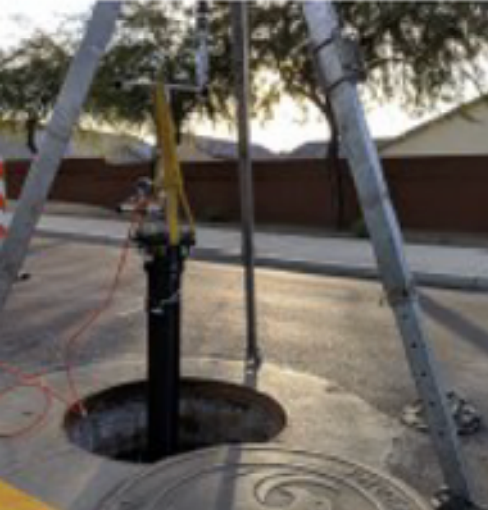
One of the insertion points of the intelligent Nautilus sphere
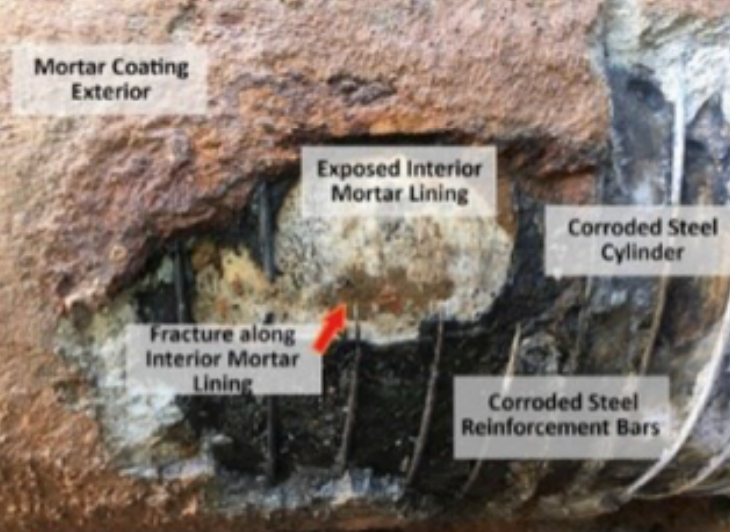
One of the leaks identified by Nautilus
Aganova and Hidromax team with the Nautilus sphere after the inspection
Results
Leaks
Incident Severity
F1
F2
F3
Total incidents
0
1
2
Air
Incident Severity
B1
B2
Total incidents
1
1
Anomalies
Incident Severity
A1
A2
Total incidents
0
0
The inspection results revealed:
- Section A: 2 verified leaks and 1 air pocket
- Section B: No leaks or anomalies
Excavations at the reported leak sites in Section A confirmed the presence of:
- Leak F1: A longitudinal crack at the 1 o’clock position with advanced corrosion.
- Leak F2: A corroded section of pipe consistent with Nautilus’ acoustic detection.
- Leak F3: A leak in an adjacent Ø450 mm cement pipe, located above and perpendicular to the tested pipe—also correctly identified by the sphere.
The air pocket location was not excavated but led to a recommendation to inspect air valves due to the associated risk of pipeline deterioration.
The Nautilus System outperformed the competing inspection solution in accuracy and costefficiency.
Conclusions
The City of Phoenix’s pilot test with the Nautilus System validated its potential as a high-value tool for water infrastructure management. Key takeaways include:
- High accuracy in leak and anomaly detection (including complex cross-pipe detection).
- Non-invasive, operationally efficient deployment with minimal disruption.
- Cost-effectiveness, outperforming traditional solutions in performance and resource requirements.
This successful pilot supports the City of Phoenix’s strategic direction in adopting smart infrastructure technologies for proactive asset management.
“Hydromax USA put Nautilus to the test in a head-to head competition in Phoenix, Arizona, on 4 miles of 20 and 24- inch bar-wrapped water main. Nautilus accurately identified 3 leaks and 1 air pocket location, outperforming the competition, and demonstrating its effectiveness, while remaining significantly more cost-effective. ”