“Who is taking the risk of trying something new?”
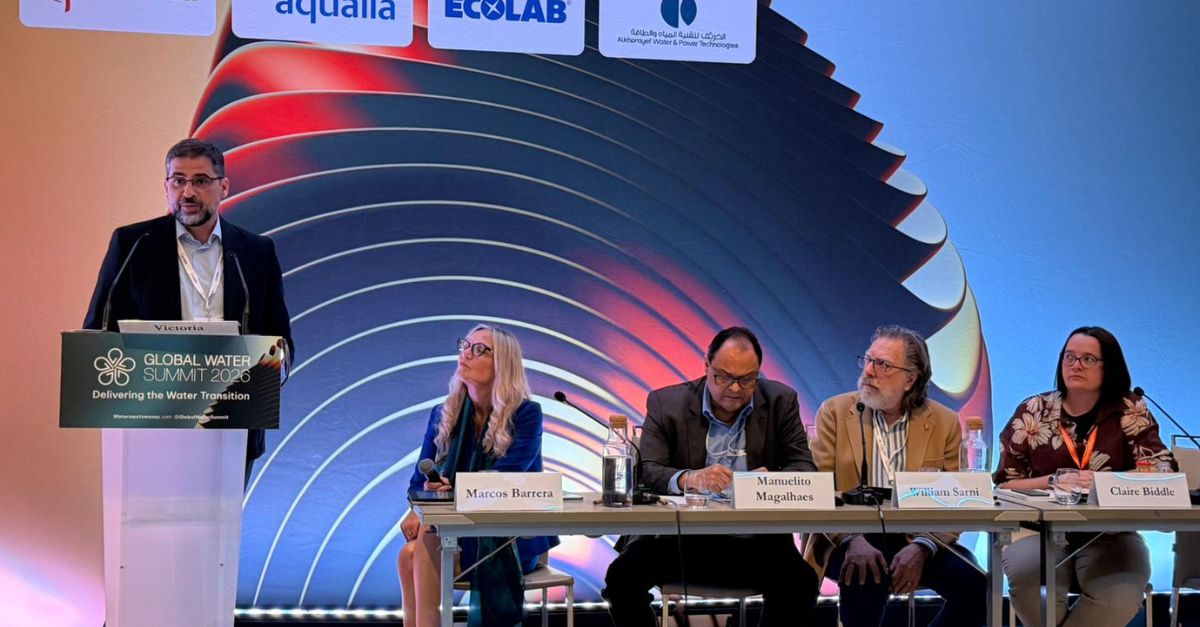
That is one question we addressed during the Global Water Summit, organised by Global Water Intelligence, in Madrid. Our CEO, Marcos Barrera, was invited to speak on a panel at the event called ‘New models for non-revenue water reduction’, which explored the emerging partnerships between corporates, start-ups and utilities.
At Aganova, we’ve been actively engaged in these partnerships, including with Amazon Web Services and SABESP in Brazil, through to Microsoft and Uisce Éireann in Ireland.
The conversation set out to address the scaling, financing and implementation of these collaborations. Will Sarni and Victoria Edwards framed the conversation around “catalytic communities”, which unite a mixture of stakeholders across a watershed, all with a common goal.
It was an interesting discussion, and thanks the panellists who joined Marcos, including Clare Biddle from Amazon and Manuelito Magalhaes from SANASA in Brazil, for their expertise and insights.
Marcos’ contribution was about scale. While distribution networks get most of the attention, on trunk mains, a single leak can outweigh the savings of an entire distribution programme. For example, while Aganova was working with a European utility on a 60km pipeline, we found three leaks. One of them was responsible for 78% of all the water lost in that stretch. That’s 788 million litres a year, from a single point.
It’s worth noting that a standard AI data centre uses around 300,000 cubic metres of water a year. One Aganova trunk main project can recover over a million. This means that a single project could potentially offset the water consumption of three data centres every year.
What makes those contracts grow is that four parties benefit from the same project. For the water utility, leaks are fixed, and it gets a better understanding of the asset condition, absorbing knowledge during the process. Meanwhile, the corporate – the source of financing for these partnerships – receives measurable, auditable savings against its water positive commitment. For the technology company, it’s a sustainable business model.
As for the community, they benefit from more efficient and resilient infrastructure. Water saved from leaks is now available for other demands.
Another important piece of the puzzle here is verification. Every volumetric benefit is confirmed through three independent layers: Aganova’s own flow rate measurement at each leak, the utility’s flow meters reading the same result, and an external engineering firm hired to audit the figure. Leak location is accurate to under a metre, and the numbers are measured, rather than modelled.
For these projects to succeed, transparency is the foundation. It is what lets the community trust that water is really being saved. Water is needed for communities, for industry, for agriculture, for everything. Collaborating to make our networks more efficient is in everyone’s interest.
Aganova recently partnered with Microsoft to launch a water replenishment project in Spain, in collaboration with Mancomunidad de Aguas del Sorbe (MAS), near Madrid, a utility that supplies drinking water to towns in 44 municipalities. Utilising AI technologies, the project is designed to modernise leak detection strategies and reduce water loss in trunk mains across MAS’ network.
This is a great example of the power of partnerships: Microsoft is funding leak identification efforts led by Aganova in MAS’s water network to conserve resources and improve resilience to drought, which shows a clear commitment to community wellbeing and environmental responsibility.
In Bergamo, Italy, Aganova and Amazon launched an AI-powered water loss reduction project in collaboration with water service provider Uniacque, which is expected to save 200 million litres of water annually.
Aganova’s acoustic leak detection technology uses AWS to host and provide data analysis capabilities, enabling Uniacque to detect leaks with high precision and speed. The AI-powered system will continuously monitor water flow in 64 kilometres of large-diameter pipelines, and analyse data in real-time using machine learning algorithms, identifying anomalies that indicate potential leaks and providing precise geolocation data to enable rapid repairs.
With Italy currently losing more than 40% of the water that enters its public supply networks through leaks, one of the highest in Europe, the potential for partnerships like these to make lasting, positive impacts should not be underestimated.
Aganova looks forward to continuing the discussion; if you’re interested in hearing more about our collaborations with corporates and utilities, please feel free to reach out directly.