Inline Leak Detection in a Newly Constructed
Transmission Main in New Mexico, USA
Executive Summary
In early 2021, the Navajo Engineering and Construction Authority (NECA), in partnership with the U.S. Bureau of Reclamation (BOR), performed a critical inspection of a newly constructed 24-inch (600 mm) fiberglass raw water transmission main in the Navajo Nation, New Mexico. Built to supply a new water treatment plant, the pipeline crosses vast and remote terrain and is subject to high pressures of up to 13 bar (200 psi). Pressure isolation tests revealed potential anomalies, prompting a proactive leak detection campaign before the system went into full operation.
To address this, NECA selected the Nautilus System, developed by Aganova and deployed in the U.S. by Hydromax USA. This free-flowing, neutrally buoyant acoustic device was inserted into the pipeline to detect and locate leaks, air pockets, and anomalies. The system successfully navigated nearly 26 kilometers despite operational challenges such as pump failures. Ultimately, four leak locations were precisely identified, enabling NECA to take timely corrective action before the pipeline was commissioned—validating Nautilus as a reliable and cost-effective leak detection solution.
Client
Partner
Sections
2 fiberglass pipeline sections
Location
Navajo Nation, NM, USA
Date
February 2021
Diameter
600 mm (24″)
Speed (m/s)
Min
Max
0.5
0.5
Pressure (bar)
Min
Max
1
13
Distance (m)
25,750
Introduction
As part of a large-scale infrastructure upgrade, NECA and BOR installed a 24-inch fiberglass transmission main to deliver raw water to a new treatment facility in the Navajo Nation. Spanning over 25 km through remote terrain, the buried pipeline had already undergone insulation testing that indicated potential leakage. NECA recognized the importance of resolving these issues prior to commissioning and sought an innovative, minimally invasive solution for accurate leak detection.
Challenge
The project posed several unique challenges:
- High operational pressures reaching 13 bar (200 psi)
- Inaccessible, remote pipeline locations
- Use of fiberglass material requiring specialized detection
- Unexpected pump failures disrupting flow during inspection
NECA needed a tool that could operate under these conditions while maintaining precision, speed, and cost-efficiency. After evaluating different technologies, NECA selected the Nautilus System for its adaptability and proven performance.
Solution and Implementation
Developed by Aganova and deployed in the U.S. by Hydromax USA, the Nautilus System uses a neutrally buoyant sphere that travels freely within the pipeline. The device records acoustic signals generated by leaks, gas pockets, and anomalies. Data is then analyzed using proprietary algorithms to determine exact locations.
Execution details:
- Insertion & extraction: Via 150 mm valve and regulation point.
- North section: 10.6 km inspected in 5h 58m with 13 synchronizers.
- South section: 14.7 km inspected in 8h 31m with 15 synchronizers.
Flow interruptions: Pump failures were handled effectively, and data analysis was successfully adapted.
Synchronizers were strategically placed to ensure spatial accuracy of findings.
The pipeline inspected had the following characteristics:
Pipeline
Characteristics
Location
Navajo Nation, New Mexico, USA
Pipeline material
Fiberglass
Diameter
600 mm (24″)
Water speed
0.5 m/s
Pressure
1 – 13 bar
Insertion point
DN150 valve (vertical access)
Extraction point
Regulation point with catch net and camera monitoring
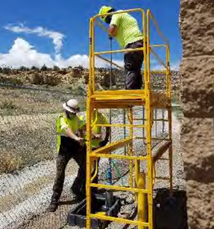
Pipeline in New Mexico, USA
Nautilus insertion
Controlled Water Discharge During Nautilus Extraction
Results
Leaks
Incident Severity
F1
F2
F3
Total incidents
1
1
2
Air
Incident Severity
B1
B2
Total incidents
0
0
Anomalies
Incident Severity
A1
A2
Total incidents
0
0
Despite the challenging field conditions—such as remote geography and pump failures—the Nautilus System successfully completed the inspection of both pipeline sections, covering a total distance of 25.75 kilometers. The system demonstrated its adaptability and robustness by maintaining data integrity and providing precise leak localization.
The final report delivered to NECA included the identification of four distinct leaks, all geolocated with respect to nearby known assets to facilitate rapid intervention. Each incident was classified by type and severity, allowing NECA to prioritize the excavation and repair efforts efficiently.
Leak Locations:
Northern Section:
- F1: 4,745 m from insertion
- F2: 9,150 m from insertion
Southern Section:
- F1: 167 m from insertion
- F3: 6,057 m from insertion
All leaks were marked with precise distances between known pipeline assets. NECA successfully excavated and repaired each one, ensuring a fully operational and leak-free system upon commissioning.
Conclusions
This project demonstrates how integrating advanced leak detection technologies—such as the Nautilus System—can significantly enhance the commissioning process of critical water infrastructure. By identifying and repairing four hidden leaks before the pipeline entered full operation, NECA avoided water loss, reduced excavation costs, and ensured the long-term reliability of the newly constructed transmission main.
The successful outcome validates Nautilus as a strategic asset for utilities operating in remote or high-pressure environments. Its accuracy, adaptability, and data-driven reporting provided NECA with actionable insights, allowing them to act decisively and protect valuable resources from day one.
“Pipeline leaks don’t always surface. The Hydromax team and Nautilus technology quickly identified our problem areas, enabling us to complete the repairs and finish the project.”