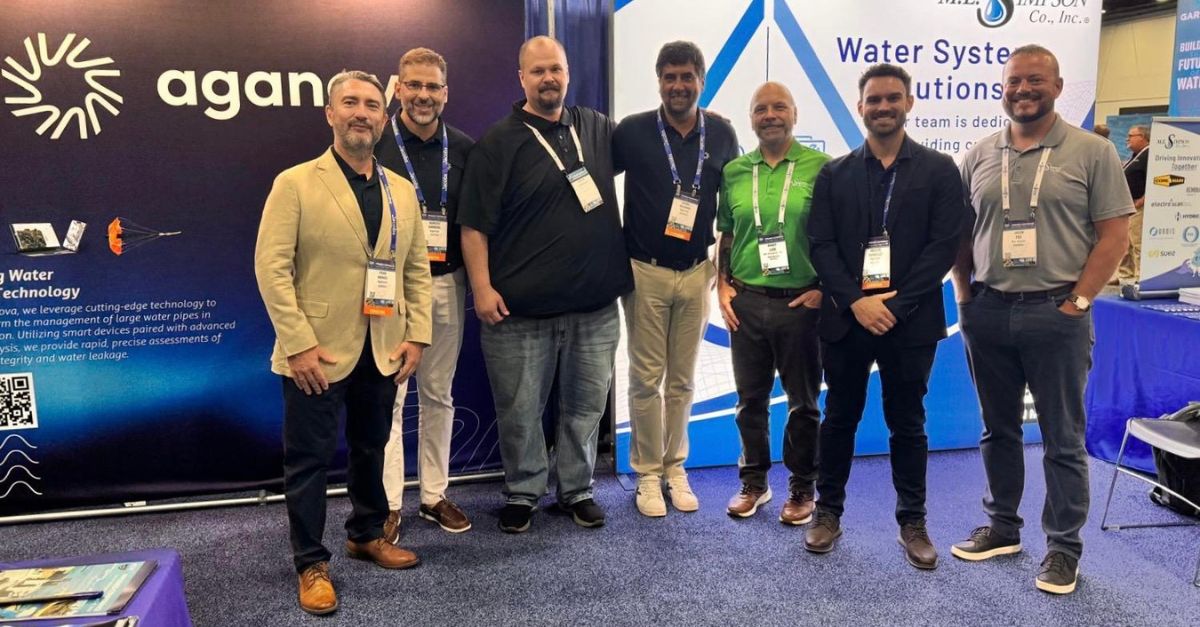
Aganova’s participation at UESI Pipelines 2026 provided valuable insight into the priorities shaping water infrastructure management in the United States. Condition assessment, data-driven investment planning and the transition from reactive maintenance to predictive asset management emerged as some of the conference’s defining themes.
Held in Detroit from August 1 to 5, UESI Pipelines 2026 brought together utility owners, engineers, contractors and technology providers to share knowledge on the planning, renewal, operation and management of pipeline assets.
Together with its U.S. partner M.E. Simpson, Aganova presented its Smart Condition Assessment approach and engaged with utilities and engineering firms from across the country. The interest generated by this model reflected one of the clearest conclusions from the event: understanding the actual condition of pipelines has become a critical priority for American utilities.
Condition assessment moves to the center of utility strategies
Throughout the technical sessions and industry discussions, it became clear that utilities are moving towards more predictive infrastructure management. Rather than responding primarily to failures, they are seeking reliable information that allows them to anticipate deterioration, assess risk and determine where investment will deliver the greatest benefit.
This shift is increasing demand for advanced pipeline condition monitoring. Utilities need to understand not only whether a pipeline is currently operating, but how its condition is evolving and which assets are most likely to require intervention.
The objective is to replace assumptions based mainly on age, material or failure history with decisions supported by direct evidence. An accurate pipeline integrity assessment can help utilities extend the useful life of assets that remain serviceable, while directing capital towards pipelines where deterioration presents a genuine operational risk.
From reactive maintenance to timely intervention
A recurring question at UESI Pipelines 2026 was when utilities should act on a deteriorating pipeline. Intervening too early may result in unnecessary expenditure, while waiting for a major failure can increase costs, service disruption and risk.
One of the main conclusions was that action should be considered when the first signs of leakage appear, particularly when leaks are associated with corrosion. In these situations, leakage may be more than an isolated operational issue: it can indicate material degradation or a loss of integrity in mechanical components such as joints.
Water leak detection therefore plays a dual role. It helps recover water that would otherwise be lost, while also providing evidence to support wider condition assessment and maintenance decisions.
This is especially relevant for large transmission mains, where failures can have significant operational, social and economic consequences. Locating a leak is not necessarily the end of the pipeline inspection process, but often the starting point for understanding why an asset is losing water and what action should follow.
Multitechnology programs and the role of engineering firms
Another clear trend was the adoption of multitechnology condition assessment programs. Presentations from utilities and engineering firms showed that no single inspection method can provide every answer across an entire network.
Instead, utilities are combining different technologies according to pipeline criticality, available data and the decisions that need to be made. Desktop analysis is commonly used as an initial prioritization tool. Electromagnetic inspection and ultrasonic testing may then be applied to critical pipelines to obtain detailed information on corrosion, wall thickness and structural condition.
For other strategic assets, intelligent free-swimming devices can locate hidden leaks and anomalies while pipelines remain in operation. This tiered approach allows utilities to select the most appropriate pipe inspection technology for each asset and reserve more complex inspection methods for pipelines where the level of risk justifies them.
Aganova’s Smart Condition Assessment model aligns closely with this approach. Through technologies such as Nautilus® and the Nemo® analytics platform, utilities can obtain actionable information from operational pipelines without interrupting supply or requiring major infrastructure modifications.
The conference also highlighted the predominant role of consulting engineering firms in the U.S. market. Utility presentations were frequently delivered alongside the engineering companies responsible for designing condition assessment programs, selecting technologies and directing their implementation.
Successful projects therefore depend on close collaboration. Utilities provide operational knowledge and define their strategic needs, engineering firms structure the program, and specialized technology providers deliver the information required to support decisions.
Strong alignment with the U.S. market
Non-Revenue Water reduction was also discussed at UESI Pipelines 2026, although it was often positioned as a natural outcome of better asset management rather than the sole objective.
When utilities improve their understanding of pipeline condition, identify hidden leaks and intervene before failures escalate, water losses decline alongside operational risk. Water loss solutions thus become part of a broader strategy that includes reliability, capital efficiency and longer asset life.
The interest generated by Smart Condition Assessment confirms the strong alignment between the challenges faced by American utilities and Aganova’s experience in water networks worldwide.
As a specialized water pipeline inspection company, Aganova helps utilities obtain precise information from large-diameter pipelines under operating conditions. Its technologies support the detection of leaks and anomalies while minimizing service disruption and implementation requirements.
UESI Pipelines 2026 showed that the future of U.S. water infrastructure management will be increasingly predictive, data-driven and multitechnology. For Aganova, the event also confirmed that Smart Condition Assessment can play an important role in helping utilities determine when to intervene, prioritize investment and protect the long-term reliability of their most critical pipelines.