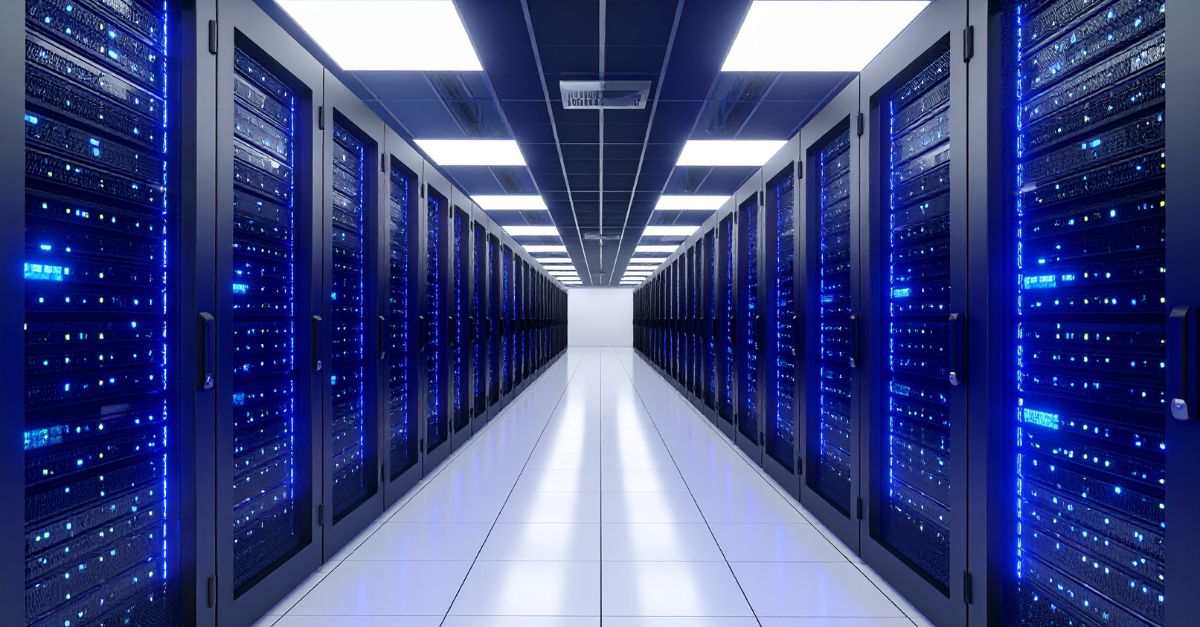
The rapid expansion of artificial intelligence and cloud computing is putting data centers at the center of a growing debate around water.
As new facilities are planned around the world, concerns about their impact on local water resources are legitimate. Data centers require water directly or indirectly, depending on their cooling systems, energy sources and local operating conditions. In water-stressed regions, every new demand on the system deserves careful scrutiny.
But there is another side of the equation that receives far less attention: the water we already have, treat and transport, and then lose before it reaches its destination.
Before asking whether a region has enough water for a new data center, industrial facility or urban development, perhaps we should also be asking a different question:
How much water could be made available by improving the infrastructure that already exists?
Water scarcity is also an infrastructure problem
Water availability is usually discussed in terms of supply and demand. How much water is available? How much will agriculture, cities and industry consume? How will climate change affect future resources?
But between supply and demand sits another critical variable: infrastructure efficiency.
The scale of the problem is significant. In her 2026 State of the Union address, European Commission President Ursula von der Leyen highlighted that European pipes lose almost one in every four litres of water, mostly through leakage. She connected the issue directly with water availability for industry and food security and announced a new European Water initiative.
This changes the perspective. At a time when Europe is debating how to secure enough water for households, agriculture, energy and industry, around a quarter of the water transported through its pipes is being lost.
Some leaks are visible. Others can remain underground for months or even years, particularly in large-diameter pipelines where conventional detection methods are difficult to apply.
That water has already been abstracted, treated, pumped and transported. Losing it means losing not only a scarce natural resource, but also the energy, chemicals, infrastructure capacity and operating costs invested in making it available.
This is where technologies for water leak detection, pipeline condition monitoring and pipeline integrity assessment can play a strategic role. Advanced pipe inspection technology can help utilities understand what is happening inside critical infrastructure, locate hidden losses and prioritize interventions.
Recovering part of that water therefore represents one of the most immediate opportunities to increase the effective availability of an existing resource, without developing a new source.
From water consumption to water replenishment
This is where the concept of water replenishment is becoming increasingly relevant.
Rather than looking only inside their own facilities to reduce consumption, companies are beginning to invest beyond their operational boundaries, supporting projects that generate measurable water benefits in the watersheds and communities where they operate.
Technology companies are among those driving this shift.
Microsoft has committed to becoming water positive by 2030 and has incorporated leak detection into its replenishment strategy. Its portfolio includes projects with utilities in which advanced leak detection identifies hidden losses in existing networks, allowing repairs to keep more water in circulation for communities.
Google has committed to replenishing more freshwater than it consumes, on average, across its offices and data centers by 2030. Meta has also established a 2030 water-positive target, while Amazon is investing in water efficiency and replenishment initiatives associated with the communities where it operates.
What these strategies suggest is an important evolution in corporate water management: the discussion is moving from simply consuming less water to actively improving the water systems on which companies and communities depend.
What if the water needed for growth is already in the network?
Leak detection offers a particularly interesting model because its impact can be direct, local and measurable.
Instead of creating a theoretical offset somewhere else, a company can support the identification and repair of leaks in the same watershed in which water is being consumed. The recovered volume remains available to the water system.
This requires collaboration between companies, utilities and specialist providers of water leak detection services and water loss solutions. The pipeline inspection process identifies losses that may otherwise remain undetected and provides utilities with actionable information to target repairs.
Aganova is already applying this model through projects involving technology companies and water utilities.
In Bergamo, Italy, Amazon and Aganova are working with utility Uniacque on an AI-powered leak detection program across large-diameter pipelines. The initiative is expected to save approximately 200 million liters of water every year, with the resulting savings verified using Volumetric Water Benefit Accounting methodology.
In Recife, Brazil, Amazon and Aganova are working with local utility Compesa to tackle water losses in a basin in the south of the city. Approximately 69 kilometers of large-diameter pipelines will be inspected using advanced in-line pipe inspection technology and AI-powered analytics. The project aims to recover 165 million liters of water annually once completed — equivalent to 66 Olympic swimming pools — while helping reduce pressure on the Boa Viagem aquifer.
In Dublin, Aganova is working with Microsoft, Uisce Éireann and SUEZ on a replenishment initiative targeting strategic trunk mains. Around 33% of Dublin’s drinking water is currently lost before reaching consumers, while 84% of the city’s supply comes from the River Liffey. By identifying hidden leaks and enabling targeted repairs, the project aims to reduce network losses and, ultimately, the amount of water that needs to be abstracted from the river.
Aganova and Microsoft have also developed a replenishment project with the Mancomunidad de Aguas del Sorbe in Spain, applying AI and advanced leak detection to reduce losses in critical water infrastructure.
These projects introduce a different way of thinking about the relationship between digital infrastructure and water infrastructure.
A successful leak detection and repair program can recover a volume of water comparable to — and, depending on the network and facility, potentially greater than — the water demand of the facilities helping to finance it.
And that recovered water is not reserved for the sponsoring company. It stays in the system.
It can supply households, hospitals, businesses, agriculture and other water-intensive industries. It can reduce pressure on rivers, reservoirs and aquifers. And because less water needs to be abstracted, treated and pumped unnecessarily, it can also reduce energy consumption and associated emissions.
The debate should not be data centers versus water
None of this eliminates the need to assess the water footprint of data centers.
New facilities must be planned according to local water availability, watershed conditions, infrastructure capacity and competing demands. Water efficiency inside the data center itself remains fundamental.
But restricting new demand without addressing existing losses tackles only one side of the equation.
In many regions, the challenge is not simply that we need more water. We need to manage the water we already have much better.
That means combining investment in ageing networks with better pipeline condition monitoring, advanced water leak detection, effective pipeline integrity assessment, faster repairs, reuse and alternative water sources where appropriate.
For a utility, choosing the right water pipeline inspection company and inspection technology is therefore not simply an operational decision. It can become part of a much broader strategy to increase water availability and infrastructure resilience.
It also requires new financing models.
Replenishment projects provide an interesting mechanism because they connect corporate water commitments with infrastructure needs that utilities may struggle to address alone. Technology companies provide investment; utilities identify priority areas and repair the network; specialist water technology companies provide the tools to find and quantify losses; and communities ultimately benefit from a more resilient water system.
The result can extend well beyond the water footprint of an individual data center.
From competition for water to investment in water resilience
The expansion of AI will continue to intensify discussion around the resources required to support digital infrastructure. Water must be part of that conversation.
But the discussion becomes much more productive when we move beyond a simple question — How much water will this data center consume? — and ask a broader one: How can investment associated with new infrastructure help make more water available for everyone?
The answer will vary from one watershed to another. There is no universal solution, and replenishment cannot replace responsible water use or sound infrastructure planning.
But when Europe is losing almost one in every four litres transported through its pipes, addressing leakage should be a fundamental part of the conversation about future water availability.
Before assuming that economic growth, new industries or digital infrastructure necessarily require more water, we should first understand how much can be recovered from the systems we already have.
Because sometimes the most sustainable new source of water is not a new source at all. It is the water we stop losing.